Brain injury support for your SmartAdvocate cases
Coordinated neurotrauma care, objective diagnostics, and practical tools for personal injury firms.
A smarter path to coordinated neurotrauma care
Braincussion, powered by All Things Neuro, gives personal injury firms one point of contact for neurotrauma referrals, objective diagnostics, and the tools their intake teams need to catch a brain injury early.
Our goal is simple: help firms identify potential brain injuries earlier, streamline the referral process, and provide a clearer path from initial concern through appropriate evaluation and care.
What this partnership gives your firm
Board-certified physicians
Objective, FDA-approved testing
Multidisciplinary concussion rehab
Explore Our Service Areas and Neurotrauma Services
Braincussion, Powered by All Things Neuro supports personal injury clients across a growing number of states through our network of neurotrauma providers and coordinated care resources.
Because service availability may vary by location, we have created an easy way for your team to identify:
The states and markets where we currently support clients
The neurotrauma services available in each location
In-person and virtual care options
The appropriate referral pathway based on the client’s needs
The best contact for questions about out-of-state cases
Whether your firm is managing a local case or assisting a client who lives, works, or receives care in another state, our team can help determine what resources may be available.
SmartAdvocate Attorney Toolkit
Our Attorney Toolkit provides practical templates, workflow suggestions, and educational resources to help your firm organize and manage potential brain injury cases within SmartAdvocate.
The toolkit may include:
Suggested neurotrauma intake questions
Client symptom follow-up templates
Case-management task suggestions
Referral and treatment tracking recommendations
Sample SmartAdvocate fields and tags
Functional-impact documentation prompts
Medical record and report tracking checklists
Suggested workflows for identifying possible TBI cases
Sample SmartAdvocate fields and tags
Resources for training attorneys, paralegals, and intake teams
Download the Attorney Toolkit
Neurotrauma symptoms checklist
Check every symptom your client reports
Brain injury symptoms are often missed at the first medical evaluation. Clients describe the pain they can point to, while headaches, dizziness, memory problems, sleep changes, and mood changes go unreported. Run this with your client, then send us what you found.
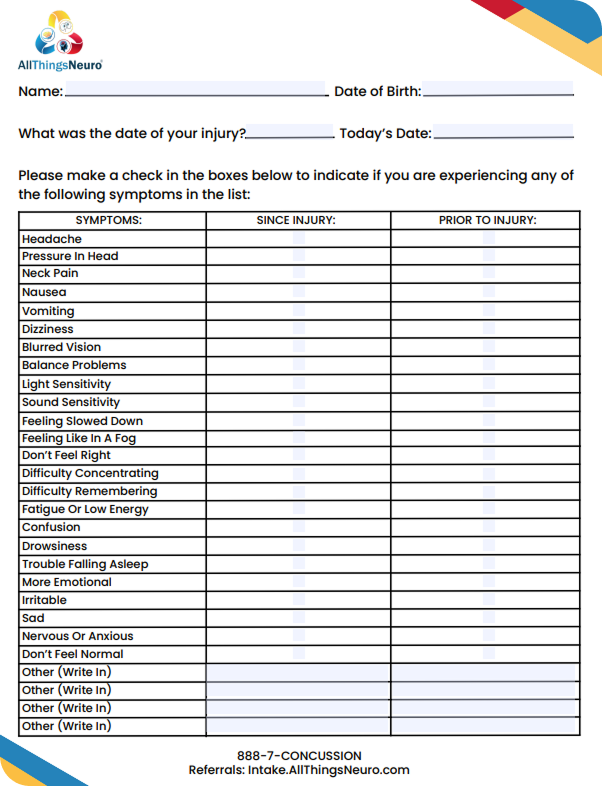
Download the printable version
The same checklist as a PDF your intake team can attach to the file or hand to a client.
Concerns?
Call our care coordination team and describe the case. We will tell you whether an evaluation is appropriate and what is available in your client's state.
888-7-CONCUSSION (266-2877)
Contact All Things NeuroThe cases you are missing are the ones nobody documented
These findings explain why fragmented diagnosis, limited follow-up, and disconnected care lead to chronic symptoms, and why coordinated, multidisciplinary neurotrauma care is essential.
Missed and Underdiagnosed
56% of mild TBI cases were not documented as mTBI in ED records.
Source: Powell et al., Arch Phys Med Rehabil (2008).
"Patients whose diagnosis is missed will typically not receive guideline-based treatment, self-care advice, or adequate follow-up care."
— Buchanan et al., Pain Physician (2023).
The Continuity Gap
39% of CT-positive patients had not seen a medical practitioner by 3 months.
Source: Seabury et al., TRACK-TBI, JAMA Network Open (2018).
"TBI is a 'chronic process', not just an isolated event requiring immediate stabilization."
— Masel & DeWitt, Journal of Neurotrauma (2010)
Chronic Symptom Load
21% had persistent post-concussion symptoms at both 3 and 12 months.
Source: Fordal et al., Arch Phys Med Rehabil (2022).
"Evaluation of specific acute symptoms and signs may contribute to the prognosis of persisting symptoms in adults."
— McIntosh et al., JAMA Network Open (2025).
Long-Term Impact
6-Month Recovery
~50% do not recover to pre-TBI levels of health by 6 months.
1-Year Impact
53% report injury-related functional limitations at 12 months.
Source: Maas et al., Lancet Neurology (2022); Nelson et al., JAMA Neurology (2019).
"The lack of coordinated care and follow-up leads to preventable long-term suffering"
Education for Your Entire Team
Braincussion, Powered by All Things Neuro hosts ongoing educational webinars for attorneys, paralegals, case managers, and medical professionals.
Topics include:
Identifying commonly missed brain injuries
Handling traumatic brain injury cases
Understanding objective diagnostic testing
Documenting functional limitations
Selecting appropriate neurotrauma providers
Navigating neuropsychological and neurological evidence
Improving communication between legal and medical teams
Book a TBI/PTSD workshop by Dr. Hertza
One Connection for Your Client’s Neurotrauma Needs
Braincussion, Powered by All Things Neuro provides access to a coordinated network of neurotrauma services through one reliable point of contact.
Depending on the client’s symptoms and clinical needs, services may include:
Neurology
Neuropsychology
Concussion and TBI evaluation
Functional neurology
Vestibular rehabilitation
Cognitive rehabilitation
Psychiatry and psychology
Physical medicine and rehabilitation
Advanced imaging
Neuro-based physical therapy
Clinical care coordination and continuity of care
Our approach is designed to be objective, conservative, and based on the individual needs of each client.
Get More From Your SmartAdvocate Workflow
A strong case-management process can help firms recognize neurological concerns earlier and maintain clearer documentation throughout the pre-litigation process.Consider incorporating the following steps into your SmartAdvocate workflow:
Screen Early
Add targeted neurological questions to the initial intake process rather than relying only on the emergency room diagnosis.
Follow Up Consistently
Symptoms may become more noticeable after the client returns to work, resumes driving, or attempts normal daily activities. Create follow-up tasks to reassess symptoms throughout the case.
Document Functional Impact
Track how the client’s symptoms affect work, memory, concentration, sleep, relationships, driving, and daily responsibilities.
Centralize Communication
Keep referral information, appointment updates, reports, and client communications organized within the case file.
Use Consistent Tags and Fields
Create standardized SmartAdvocate fields or tags for potential concussion, TBI symptoms, neurological referral status, upcoming evaluations, and received reports.
Track the Client’s Care Pathway
Use tasks and status updates to make sure referrals are completed, reports are received, and the legal team stays informed.
FAQ
Frequently Asked Questions
Who is Braincussion, Powered by All Things Neuro?
All Things Neuro helps identify neurotrauma earlier through objective diagnostics and coordinated clinical care, so attorneys have greater clarity, clients receive the appropriate care sooner, and the right treatment pathway can begin. Our team works with personal injury law firms and medical providers to simplify access to neurotrauma services, improve communication, and support continuity of care. Braincussion is how that network reaches personal injury firms — one reliable point of contact for neurotrauma referrals.
When should my firm refer a client?
If a client reports headaches, dizziness, memory problems, sleep changes, or emotional changes after a traumatic event, that is enough to start. Brain injury symptoms are not always recognized during the initial medical evaluation, particularly when the client is focused on orthopedic pain. You do not need a diagnosis before referring. Run the neurotrauma symptoms checklist with your client, or call our care coordination team and describe the case — we will tell you whether an evaluation is appropriate.
What if my client lives or receives care in another state?
We support personal injury clients across a growing number of states through our network of neurotrauma providers and coordinated care resources. Because availability varies by location, our states and services page shows where we currently support clients, which neurotrauma services are available in each location, and whether in-person or virtual care applies. Whether your firm is managing a local case or assisting a client in another state, our team can help determine what resources may be available and who the best contact is.
How objective are the findings?
Our approach is designed to be objective, conservative, and based on the individual needs of each client. Every referral enters the same clinical pathway, and recommendations follow from the client's symptoms and clinical need rather than from who sent them to us. Documentation returns to your team so you can see what was assessed and what was recommended.
Let’s Make the Referral Process Easier
Whether your firm has a client with persistent headaches, dizziness, cognitive concerns, memory problems, emotional changes, or other possible neurological symptoms, our team can help identify an appropriate next step.
The information and resources on this page are provided for educational purposes and are not intended as legal or medical advice. Clinical recommendations and treatment decisions are based on the individual needs of each patient.
Follow the journey
Real stories, education, and behind-the-scenes from our neurotrauma team. Connect with us across your favorite platforms.