
Blog
Advocates
Vertebral Artery Dissection and Delayed Symptoms: Why the Timeline Matters
Vertebral artery dissection can cause delayed symptoms after a crash, fall, or other neck injury, sometimes appearing days after the initial event. Recognizing worsening neck pain, severe headaches, dizziness, vision changes, and other neurological warning signs can help prevent serious complications.
Board-certified physicians
Objective, FDA-approved testing
Multidisciplinary concussion rehab
The crash didn't seem like much. A bumper tap at a red light, a stiff neck that evening, maybe a couple of ibuprofen before bed. You told everyone you were fine.
Then, four days later, a headache settled in at the base of your skull and wouldn't let go. The room tilted when you stood up from the couch. Sometimes that slow build traces back to a small tear inside a neck artery. It started on the day of the injury and kept quietly developing.
What a Vertebral Artery Dissection Actually Is
Two Arteries Most People Never Think About
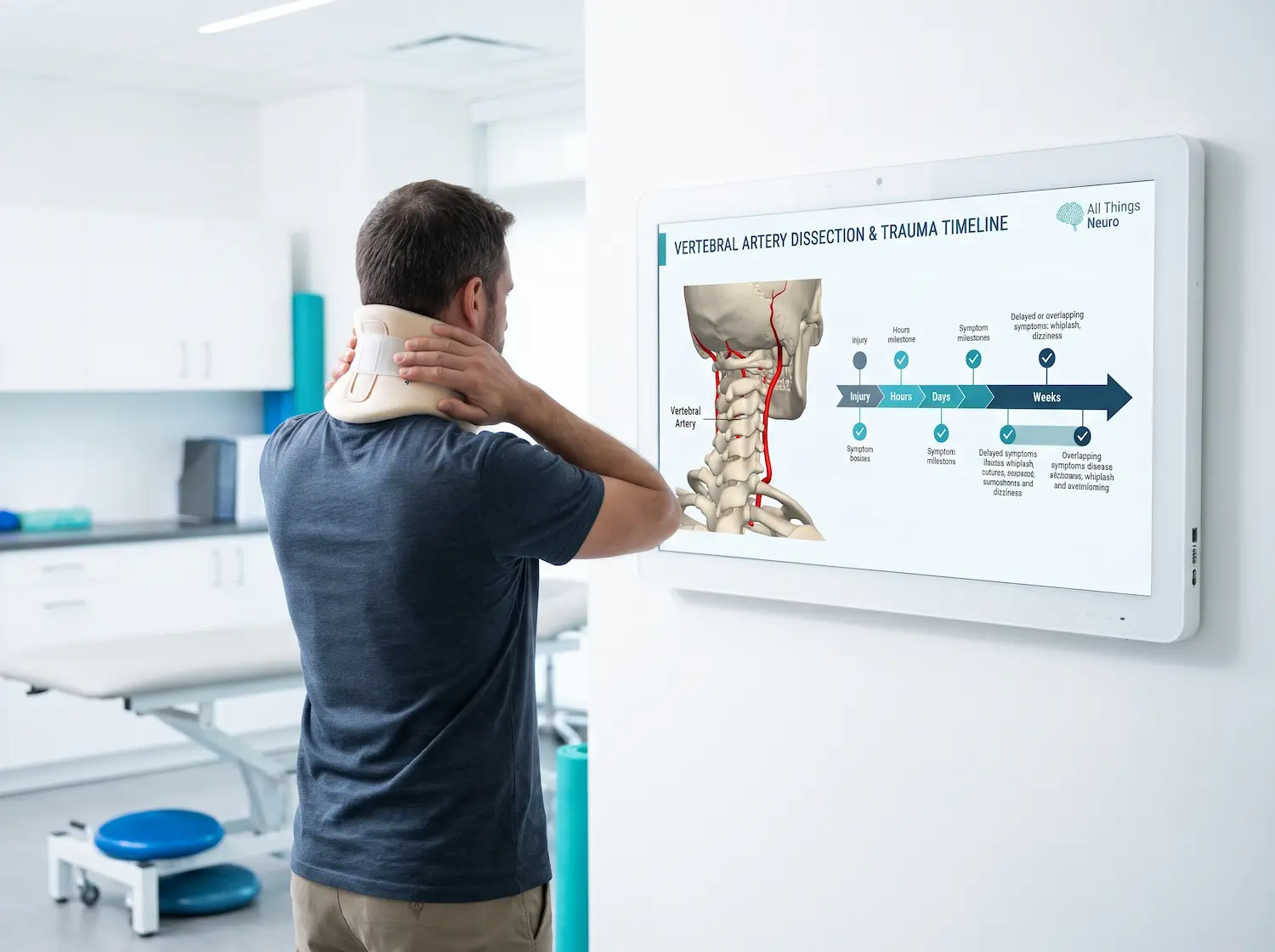
You have two vertebral arteries, one on each side of your neck. They travel upward through small openings in the neck bones and join at the base of the skull. Together, they feed the brainstem, the cerebellum, and the back of the brain. These areas control balance, coordination, and vision.
How a Small Tear Becomes a Big Problem
A dissection is a tear in the artery's inner lining. Blood slips into the wall of the vessel and separates its layers. From there, a few things can happen:
- The artery wall swells inward and narrows the channel for blood flow
- A clot forms at the damaged spot
- A piece of that clot breaks loose and travels toward the brain
Traumatic vs. Spontaneous Dissection
Some dissections happen with no clear trigger. Others follow a physical event that stretched, twisted, or struck the neck. VAD is also a recognized cause of stroke in younger adults, a group that rarely expects stroke to be a possibility.
Why VAD Symptoms Can Show Up Late
The Tear and the Stroke Are Not Always the Same Event
The dissection may happen at the moment of impact. The consequences often arrive later. A clot can take time to form, grow, and break loose, and narrowing can worsen gradually. So the day of the injury and the day of the neurological symptoms may be separated by hours, days, or longer.
Adrenaline, Pain, and Louder Injuries Can Mask Early Signs
Right after a crash or fall, stress hormones dull pain. Attention also goes to whatever hurts most. By the time neck symptoms get noticed, many people have already returned to work.
What Research Says About the Delay Window
Published research gives a clearer picture of how long that gap can be:
- In a study of 26 VAD patients in the Canadian Journal of Neurological Sciences, headache or neck pain was the main symptom in 88% of cases.
- In 53% of those patients, that pain came before a stroke by as many as 14 days.
- A case report in the Journal of Medical Case Reports noted the gap is usually under 24 hours, but delays of up to six weeks have been documented.
- Clinical references generally treat the first two weeks after a dissection as the highest-risk period for stroke.
Vertebral Artery Dissection Symptoms Worth Taking Seriously
Early Warning Signs
Early VAD symptoms are easy to dismiss because they resemble ordinary soreness. Watch for:
- Neck pain, often on one side and toward the back
- A headache at the base of the skull
- Pain that keeps getting worse instead of easing
Neurological Symptoms After Injury That Signal Trouble
When blood flow to the back of the brain is affected, symptoms usually involve balance, vision, and coordination:
- Dizziness or a spinning sensation (vertigo)
- Double vision or blurred vision
- Unsteady walking or clumsiness on one side
- Slurred speech or difficulty swallowing
- Nausea and vomiting
- Numbness or tingling in the face or body, often on one side
Red-Flag Checklist: When to Call 911
Sudden neurological symptoms need emergency care, not a scheduled appointment. The BE FAST acronym supported by the American Stroke Association helps identify when immediate intervention is essential:
- Balance: sudden dizziness, loss of balance, or trouble walking
- Eyes: sudden vision loss or double vision
- Face: one side of the face droops or goes numb
- Arms: weakness or numbness in an arm or leg
- Speech: slurred speech or trouble finding words
- Time: call 911 right away and note when symptoms started
When VAD Looks Like Concussion or Whiplash
Why the Overlap Causes Missed Diagnoses
Headaches, dizziness, nausea, and vision changes can appear in concussion, whiplash, and VAD. Someone diagnosed with a concussion after a crash may assume new symptoms are part of the same recovery. That overlap is one reason dissections are sometimes identified late, especially in younger patients.
What Family Members Often Notice First
People with a developing problem don't always recognize it in themselves. Spouses, parents, and coworkers often catch it first. Pay attention if your loved one:
- Stumbles or reaches for walls more than usual
- Complains that the room is spinning
- Slurs words or seems to search for them
How Vertebral Artery Dissection Is Diagnosed
Imaging That Confirms a Dissection
A dissection is confirmed through vascular imaging, which shows the arteries themselves. Comprehensive literature accessible through PubMed / NCBI confirms that non-invasive vascular studies are critical for establishing timely clinical management. Common options include:
- CT angiography (CTA): a CT scan with contrast dye that outlines the blood vessels
- MR angiography (MRA): an MRI-based view of blood flow and vessel walls
- Brain MRI: to check whether a stroke has already occurred
Where Neurological Evaluation Fits In
Imaging confirms the artery injury. A neurological evaluation shows how symptoms affect daily function. At All Things Neuro, our team uses objective tools such as oculomotor and vestibular testing to measure eye movement, balance, and coordination. These results can help document deficits and support coordination with a patient's broader care team. Rooted in our overarching mission & vision, our approach ensures that recovery is mapped with clinical precision and objective clarity.
Why the Timeline Matters for Care and for the Case
For Recovery and Stroke Prevention
Stroke risk after a dissection appears highest in the early weeks. Once a dissection is identified, doctors may recommend antiplatelet or anticoagulant medication to help lower clot risk. Research comparing those two approaches has found similar results. Either way, treatment can only begin once someone recognizes the problem.
For Personal Injury and Workers' Comp Documentation
Delayed VAD symptoms create a predictable challenge in legal and claims settings. Insurers frequently point to a "gap in treatment" to argue that something other than the accident caused the injury. A well-documented timeline helps address that argument by showing:
- When the injury happened and how the neck was involved
- When the first symptoms appeared, even mild ones
- When neurological symptoms developed
- What testing and imaging confirmed
How Attorneys and Case Managers Can Protect the Record
Referral partners can play a real role in keeping the record intact. Practical steps include:
- Encouraging prompt evaluation when a client mentions new headaches, dizziness, or vision changes
- Asking clients to keep a dated symptom log
- Requesting complete imaging reports, not only summaries
- Connecting clients with objective neurological testing to document functional deficits
For expert analysis, BrainTrust is the legal-support arm of All Things Neuro. It provides expert witness testimony, independent medical examinations (IMEs), and impairment ratings. That gives attorneys and case managers in Georgia and Ohio direct access to clinical expertise built for legal and workers' comp settings. To discover more about our clinical credentials, read more about us, or join our upcoming professional events.
Late Symptoms Still Belong to the Original Injury
A body doesn't always report damage on schedule. An artery that tore during a fall can stay quiet for days. That delay says nothing about whether the injury is real.
What changes the outcome is attention. Noticing a new headache, writing down when dizziness started, and getting evaluated sooner all protect your health. Those same steps also create a record that holds up when someone asks what happened and when.
Let's Talk Through What You've Been Noticing
New symptoms after an accident or workplace injury deserve a closer look, and our team at All Things Neuro can help. We provide objective neurological testing and evaluations that document how an injury is affecting balance, vision, and cognition across our service network in multiple states and regional locations. Attorneys, case managers, and referring providers are welcome to contact us and discuss how we support patients and documentation needs.
📞 888-7-CONCUSSION 🌐 allthingsneuro.com 📍 3535 Peachtree Road NE, Suite 320, Atlanta, GA 30326
Follow us: Facebook | Instagram | LinkedIn
Wellness Disclaimer: This content is for informational purposes only and does not constitute medical advice. Please consult a qualified healthcare provider for diagnosis and treatment. If you experience sudden neurological symptoms, call 911 immediately.
Legal Disclaimer: This content does not constitute legal advice and does not predict or guarantee the outcome of any personal injury or workers' compensation claim. Please consult a licensed attorney about your specific situation.