Blog
Patients
The Benefits of Telehealth for Brain Injury Care
Telehealth can make brain injury care easier to reach by reducing travel, letting patients be seen in a comfortable setting and making it simple for family to join. Early research suggests video visits can be a practical option for many concussion and neurology patients, while some assessments still require an in-person visit.
Board-certified physicians
Objective, FDA-approved testing
Multidisciplinary concussion rehab
Brain Injury Care From Home: The Benefits of Telehealth
After a concussion or brain injury, getting to an appointment can be one of the hardest parts of the day. Driving can feel daunting when you're dizzy or your vision is off. Bright lights, traffic and a busy waiting room can make a headache worse before the visit even starts.
Telehealth brings part of that care to you. With a phone or computer and a quiet room, patients can talk with a brain injury specialist without the drive, the parking lot or the fluorescent lights. For many people and their families, that makes the first step toward answers feel a lot more manageable.
What Telehealth Looks Like for Brain Injury Care
A telehealth visit is a live video appointment with a specialist, held from home on a smartphone, tablet or computer. It looks a lot like an in-office visit, just without the commute.
During a virtual visit, a specialist can:
- Review your injury, medical history and current symptoms
- Ask detailed questions about sleep, mood, focus, headaches and balance
- Observe certain movements and responses on camera
- Walk you and your family through results and recommended next steps
- Check in on progress during follow-up visits
At All Things Neuro, telehealth may be appropriate depending on the patient, the service and the state. Some services can happen fully online, while others need an in-person visit. Our team will let you know which parts of your care can be done virtually.
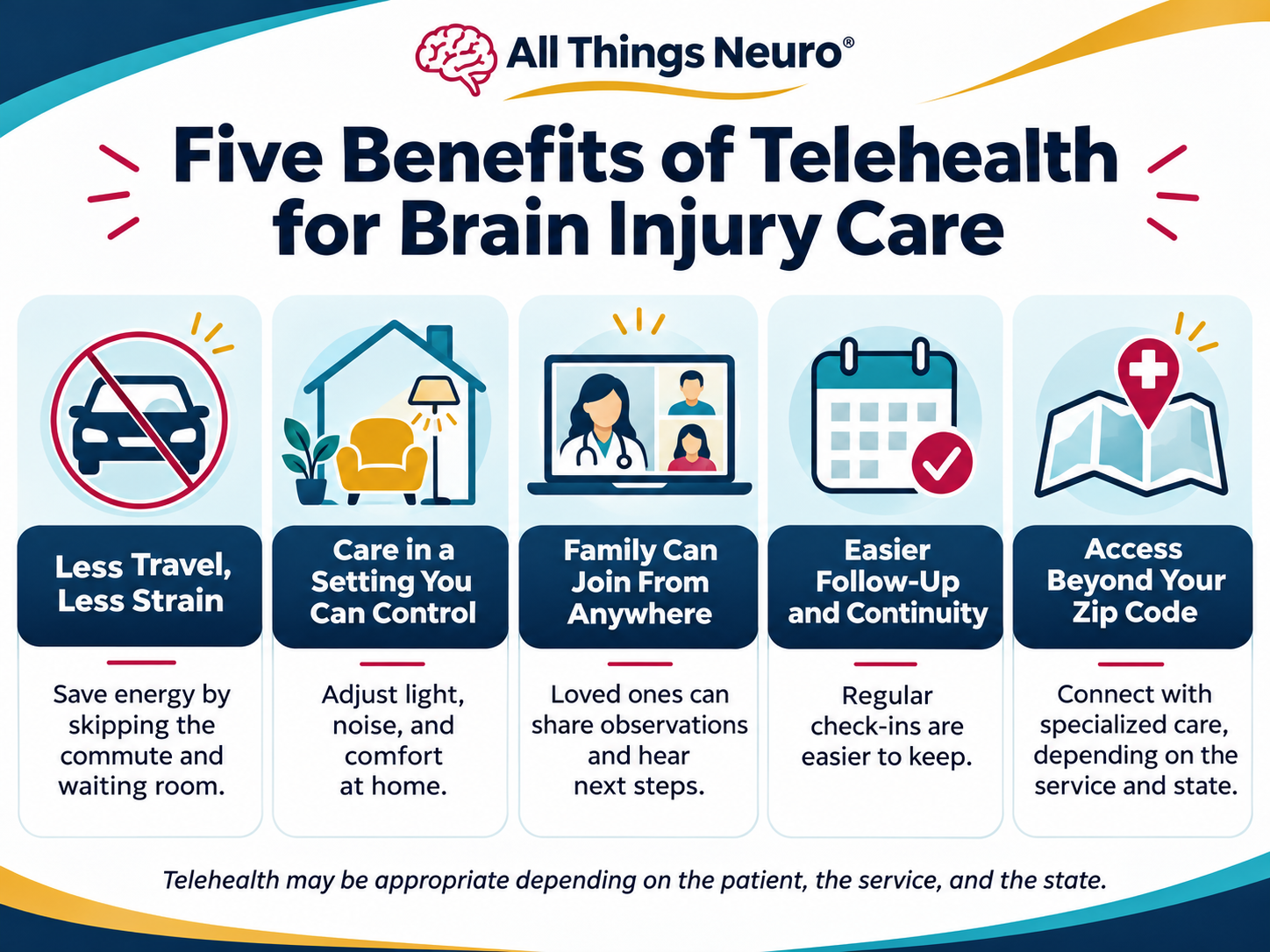
Five Benefits of Telehealth for Brain Injury Care
1. Less Travel, Less Strain
For someone with dizziness, light sensitivity or fatigue, a long drive and a busy clinic can take a real toll. A video visit removes the commute and the waiting room, so patients can save their energy for the conversation that matters.
2. Care in a Setting You Can Control
At home, patients can dim the lights, turn down the noise and sit somewhere comfortable. That control can make it easier to focus, describe symptoms clearly and get more out of the visit.
3. Family Can Join From Anywhere
Family members often notice changes in mood, memory or behavior before the patient does. With telehealth, a spouse at work or an adult child in another city can join the same video call and share what they've seen.
4. Easier Follow-Up and Continuity
Recovery after a brain injury isn't always a straight line, and regular check-ins matter. When follow-up visits don't require a half day off work, patients are more likely to stay connected to their care team over time.
5. Access Beyond Your Zip Code
Specialized brain injury care isn't available in every community. Telehealth can connect patients with specialists who aren't nearby, depending on the service and the state where they live.
What the Research Says
Early research suggests telehealth can be a practical option for many concussion and neurology patients. In 2019, the American Academy of Neurology issued a position statement that telemedicine can be appropriate for evaluating patients with concussion, traumatic brain injury or headache (source).
These are small or early studies, and more research is needed. One detail from the last study stands out: about 30% of the patients lived within 50 miles of the clinic. The researchers suggested telehealth helps people access care for reasons beyond distance alone.
When an In-Person Visit Still Matters
Telehealth is a powerful tool, but it doesn't replace every part of brain injury care. Some assessments use specialized equipment that is only available in a clinic, and some exams are best done face to face. Your specialist will recommend the right mix of virtual and in-person care for your situation.
Telehealth is also not for emergencies. If someone has a severe or worsening headache, repeated vomiting, a seizure, growing confusion, slurred speech, or weakness or numbness, call 911 or go to the nearest emergency room right away.
Tips for a Great Virtual Visit
A little preparation helps you get the most out of a telehealth appointment:
- Find a quiet, comfortable spot. Choose a room with minimal noise and lighting you can adjust.
- Lower your screen brightness. If screens bother you, dim the display and sit a comfortable distance away.
- Test your connection early. Log in a few minutes before the visit to check your camera, microphone and internet.
- Write down your symptoms and questions. Note when symptoms started, what makes them better or worse, and anything that has changed.
- Invite a family member. A loved one can share what they've noticed and help remember next steps. Our caregiver observation checklist is a helpful place to start.
- Take breaks if you need them. It's okay to tell your specialist if you need a moment to rest.
Getting Started With All Things Neuro
If you or someone you care for has felt off since a head injury, a telehealth visit may be an easier first step. Patients can request an appointment through our online form at intake.allthingsneuro.com, and our team follows up to coordinate scheduling and access. Telehealth may be appropriate depending on the patient, the service and the state. Our specialists interpret results alongside the patient's history and recommend appropriate next steps.
888-7-CONCUSSION · allthingsneuro.com · 3535 Peachtree Road NE, Suite 320, Atlanta, GA 30326
Follow us: Facebook | Instagram | LinkedIn
Wellness Disclaimer: This content is for informational purposes only and does not constitute medical advice. Please consult a qualified healthcare provider for diagnosis and treatment.
Sources
- Ohio State University Wexner Medical Center, "Telemedicine option for concussion care does not impair treatment options," AAN 2025 abstract
- Elbin et al., "In-Person Versus Telehealth for Concussion Clinical Care in Adolescents," Journal of Head Trauma Rehabilitation, 2022
- Ross et al., "Implementation and Patient Experience of Outpatient Teleneurology," Telemedicine and e-Health, 2021