
%20(4).png)
Blog
Attorneys
The Future of TBI Causation: How Biomechanics and AI Are Changing Brain Injury Litigation
Attorneys handling traumatic brain injury cases face increasingly complex questions about causation, imaging, and medical evidence. In this article, Dr. Rami Hashish, founder of the National Biomechanics Institute, shares how biomechanics, AI-powered medical record review, and individualized injury analysis are transforming the future of brain injury litigation.
Board-certified physicians
Objective, FDA-approved testing
Multidisciplinary concussion rehab
This article was inspired by a recent educational webinar hosted by All Things Neuro featuring Dr. Rami Hashish, PhD, DPT, founder of the National Biomechanics Institute.
For attorneys handling traumatic brain injury cases, one of the most difficult questions is often not whether a client is suffering, but whether the injury can be clearly connected to the mechanism of the accident.
A client may report headaches, dizziness, cognitive fatigue, memory issues, mood changes, or difficulty returning to work. Medical records may document the symptoms. Treating providers may agree that something changed after the incident.
Then comes the challenge:
Was the force involved in the accident capable of causing the injury being claimed?
That question sits at the heart of many personal injury, workers’ compensation, and complex neurotrauma cases.
Recently, All Things Neuro hosted an educational webinar featuring Dr. Rami Hashish, PhD, DPT, founder of the National Biomechanics Institute, to discuss how biomechanics, artificial intelligence, and evolving injury science are reshaping the way attorneys evaluate traumatic brain injury causation.
Why Two People Can Experience the Same Accident Differently
One of the most memorable concepts discussed during the webinar involved a simple rubber band.
Imagine a brand-new rubber band.
You stretch it, and it snaps right back.
You stretch it again, and it still holds.
Over time, however, that rubber band changes. It weakens. It loses some of its original resilience. Eventually, one final stretch may cause it to snap.
The final stretch may not look dramatically different from the stretches that came before it.
What changed was the condition of the rubber band.
Dr. Hashish used this type of concept to explain why injury causation cannot always be reduced to the accident alone. The individual matters.
Age, prior injuries, chronic health conditions, physical conditioning, tissue tolerance, and overall physiological resilience can all influence how someone responds to force.
This is especially important in traumatic brain injury cases.
Two people may be involved in the same collision. One may recover quickly. Another may experience persistent symptoms, disrupted function, and a long road back to stability.
For attorneys, that distinction matters.
A proper causation analysis should not simply ask, “Was the crash severe enough?”
It should also ask, “Who was this person when they got into the vehicle that day?”
Who Is Dr. Rami Hashish?
Dr. Rami Hashish, PhD, DPT, is a biomechanics expert, technology entrepreneur, and founder of the National Biomechanics Institute.
His work focuses on injury causation, accident reconstruction, human movement, and the relationship between external forces and bodily injury. He has consulted on legal cases involving motor vehicle collisions, workplace injuries, sports injuries, aviation incidents, and other complex injury scenarios.
Dr. Hashish also helped develop pareIT, an AI-powered medical record summarization platform designed for the medical-legal space. That work reflects a broader shift in litigation: attorneys are increasingly looking for better ways to organize, understand, and evaluate complex medical information before and during litigation.
What Is Forensic Biomechanics?
Forensic biomechanics examines how forces interact with the human body.
In legal cases, that may include analyzing:
- The mechanics of a motor vehicle collision
- The movement of the body during impact
- Whether the forces involved are consistent with the claimed injuries
- How age, prior injury, health status, or vulnerability may affect injury response
- Whether the mechanism of injury aligns with the medical findings
Biomechanics does not replace medical diagnosis. It answers a different but related question.
A physician may determine what injury or condition exists.
A biomechanical expert may help evaluate whether the described event could plausibly produce the injury pattern being claimed.
For traumatic brain injury cases, that can be especially important because symptoms are often complex, imaging may not tell the whole story, and recovery can vary significantly from person to person.
Why Imaging Alone May Not Tell the Full Story
During the webinar, Dr. Hashish discussed an important concept for brain injury cases: severity and imaging do not always align in the way attorneys or jurors may expect.
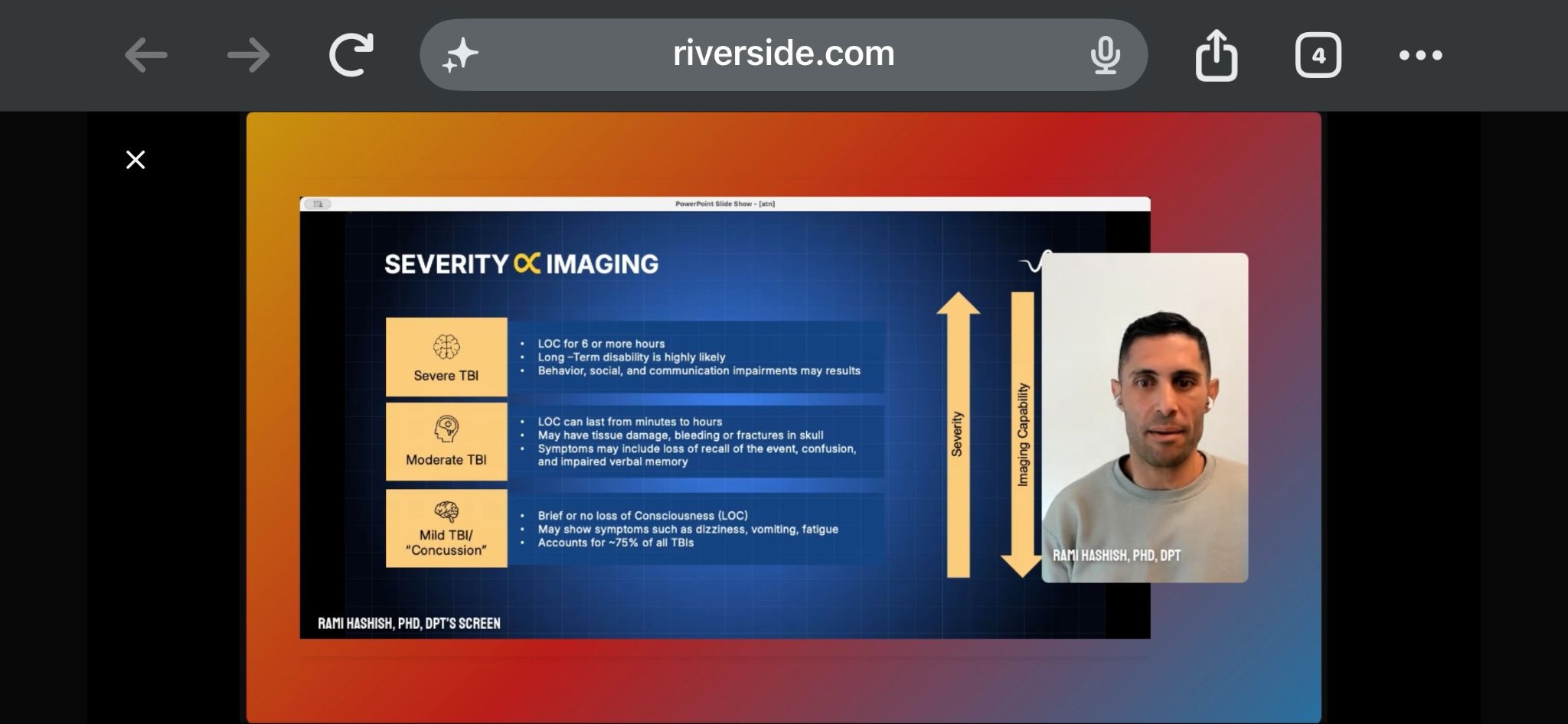
This matters because many concussion and mild traumatic brain injury cases involve symptoms that affect function rather than obvious structural damage visible on standard imaging.
A client may experience:
- Cognitive fatigue
- Dizziness
- Headaches
- Light or noise sensitivity
- Memory problems
- Difficulty concentrating
- Emotional changes
- Work performance decline
Yet standard imaging may not fully explain those symptoms.
That does not automatically prove causation. But it does mean attorneys should be careful about treating “normal imaging” as the end of the analysis.
In many TBI cases, the more important question is not simply what the image shows, but how the person functions after the event compared to before.
Case Scenario: The “Low Impact” Collision With Long-Term Symptoms
Consider a common scenario.
A client is involved in a rear-end collision. Property damage appears modest. The emergency room records do not show a dramatic acute finding. The client is discharged.
Weeks later, however, the client reports:
- Ongoing headaches
- Dizziness
- Trouble focusing
- Slower processing speed
- Mood changes
- Difficulty returning to work
The defense position may be predictable:
“This was a minor collision. The forces were not enough to cause a traumatic brain injury.”
But a deeper analysis may raise more nuanced questions.
What was the client’s age?
Did they have prior concussions?
Were there pre-existing neck, vestibular, neurological, or cognitive vulnerabilities?
What direction did the force come from?
Was there rapid acceleration or deceleration?
Did symptoms begin soon after the incident and follow a consistent timeline?
Do treatment records show persistent functional decline?
Did neuropsychological, vestibular, neurological, or other objective evaluations identify patterns consistent with the complaints?
Biomechanics does not simply look at the vehicle. It looks at the event, the movement, the forces, and the person exposed to those forces.
That is where modern causation analysis becomes more sophisticated.
Where AI Fits Into Medical-Legal Case Review
Another important discussion from the webinar involved artificial intelligence and medical record review.
Attorneys handling traumatic brain injury cases often face a mountain of documentation:
- Emergency room records
- Primary care notes
- Neurology records
- Therapy notes
- Imaging reports
- Neuropsychological evaluations
- Medication histories
- Prior medical records
- Billing records
- Disability or work-status documentation
In complex injury litigation, important patterns can be buried inside hundreds or thousands of pages.
AI-assisted tools like pareIT are designed to help organize and summarize medical records more efficiently. These tools may help attorneys identify timelines, treatment patterns, symptom progression, prior conditions, and areas that may require further expert review.
That does not mean AI decides whether a case is valid.
It should not replace attorneys, physicians, or expert witnesses.
But it may help legal teams spend less time searching through records and more time analyzing what the records actually mean.
For attorneys evaluating traumatic brain injury cases, that efficiency can be valuable at the intake stage, during case development, and while preparing expert review.
Why This Matters for TBI Litigation
Traumatic brain injury cases are often difficult because they sit at the intersection of medicine, function, science, and lived experience.
A client may look “fine” but struggle to work.
A scan may appear normal while cognitive testing reveals functional impairment.
A collision may be described as minor while the injured person’s biological vulnerability tells a more complicated story.
A medical record may document symptoms, but the mechanism of injury may still be challenged.
That is why the future of TBI litigation will likely depend on better integration between:
- Neurology
- Neuropsychology
- Rehabilitation medicine
- Biomechanics
- Medical record analysis
- Functional outcome documentation
- Artificial intelligence tools that improve organization and efficiency
The strongest cases are rarely built from one piece of evidence.
They are built from patterns.
Practical Takeaways for Attorneys Handling TBI Cases
Attorneys evaluating traumatic brain injury claims should consider:
1. Look Beyond the Crash Description
Do not rely only on property damage or broad assumptions about impact severity. The mechanism matters, but so does the person.
2. Pay Attention to the Pre-Incident Baseline
A strong case analysis should consider the client’s health, function, work ability, prior injuries, and medical history before the accident.
3. Track Symptom Progression Carefully
Timeline matters. When did symptoms appear? Did they persist? Did they change? Were they documented consistently across providers?
4. Understand the Limits of Imaging
Normal imaging does not automatically mean normal function. Imaging should be interpreted in context with symptoms, exam findings, and functional testing.
5. Use Experts Strategically
Biomechanical experts, neurologists, neuropsychologists, and rehabilitation professionals may each answer different parts of the causation and damages picture.
6. Use Technology to Organize, Not Replace, Legal Judgment
AI-assisted medical summarization can help identify patterns and reduce review burden, but expert interpretation and legal strategy remain essential.
The Future of Injury Causation Is More Individualized
The biggest lesson from Dr. Hashish’s presentation may be this:
Injury causation is not one-size-fits-all.
It is not enough to ask whether an average person would be injured in an average accident.
Real cases involve real people with real histories, vulnerabilities, strengths, and biological differences.
For attorneys, that means the future of traumatic brain injury litigation will require more than broad assumptions about crash severity.
It will require a more complete understanding of:
- The force
- The mechanism
- The person
- The symptoms
- The medical history
- The functional outcome
- The science connecting them
As biomechanics and AI continue to evolve, attorneys who understand these tools will be better positioned to evaluate claims, prepare experts, respond to causation challenges, and advocate for clients whose injuries may not be obvious at first glance.
Final Thought
Traumatic brain injury litigation is changing.
The future belongs to attorneys who can move beyond speculation and toward clearer, more evidence-informed case analysis.
Dr. Rami Hashish’s work highlights where the field is headed: a future where biomechanics, medical expertise, artificial intelligence, and individualized patient analysis work together to better understand how injuries happen and why recovery looks different for every person.
For attorneys handling complex TBI cases, that future is already here.
.png)

.png)